
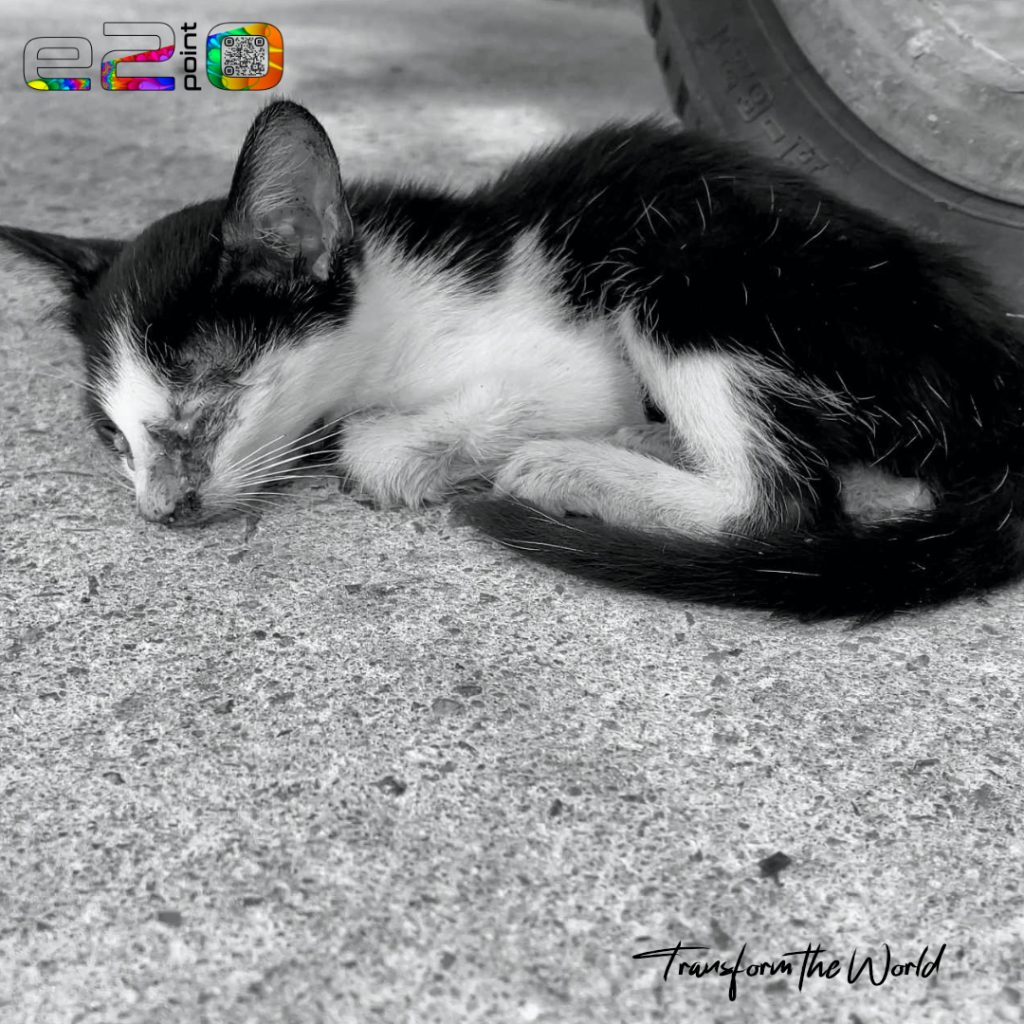
This image may be confronting for some, my apologies, but it’s necessary and relevant to the text on compassion below. The colour has been removed to soften it.
I came across this gravely ill female kitten huddled under a broken cart at a busy transport pier in southern Thailand. Hundreds of people had already walked past her, and many more were still passing by and clearly, none had stopped to help.
My boat, a longtail, Thai-style transport vessel common in more remote regions was due to leave in 20 minutes. These boats come and go all day, moving between the lesser-touristy islands, carrying supplies, local people, and rubber plantation harvests.
It was the last boat of the day: the 6 p.m. ferry from Laem Kruat Pier to Koh Jum Island, where I rented a village house. At the time, I was caring for about 9 rescue cats and all of them were waiting for me to return and feed them.
I spent those 20 minutes buying her some food to see if she would eat (she didn’t) and asking up and down the street if anyone owned her or wanted to help. No one showed any interest nor even any concern, everyone too busy with the commerce and trade of the port.
It was clear to me that I couldn’t leave her there to die, a choice everyone who passed by her that day had made without even a second glance. Female cats in these parts are often left to die if they’re sick; the locals don’t want another litter of kittens to deal with, and their immediate family’s needs come first.
I’m writing this now because I’ve thought about my decisions and choices over these last couple of years, spending most of my time, and what resources I have, rescuing abandoned cats in poorer Asian communities. I’ve thought about the risks: going out on a limb, taking a leap of faith, watching a draining bank account, and seeing nothing coming in to replenish it.
And so the question has naturally arisen: Would I have walked past this kitten that evening? Could I have walked past this kitten, or any of the dozens of other cats I’ve come across over these years, all needing immediate action and attention to either support them or save them?
Would there have been anything more important back then than stopping to take her home with me?
Would I have chosen to keep an appointment, perhaps a dinner date or night out with friends, and leave her there to die like everyone else had?
No.
What if I had a bus or flight to meet, taking me to my next destination? What if I was on my way to the airport? Would I have left her then? No, I would have changed my plans.
Could there have been anything, I’ve asked myself, that might have enticed or distracted me from lifting her into my chest, taking her home, and doing whatever I could, within the scope of possibility to help her, heal her, and give her a chance at a beautiful life? A life full of kindness and play, long sleeps in the sun or curling up in the lap of a child who loved her, a life that had so far passed her by?
Absolutely not.
Nothing, except an emergency of my own, would have stood in the way or felt more important to me at that moment than her need for my compassion.
And this speaks volumes about the nature of compassion, reflecting its essence, unrestrained by logic, reason, or calculation. It perceives and responds in ways that value, support, and nurture life above all other intellectual hierarchies of importance.
Compassion has enough to give to everything, to everyone, endlessly. It is like the unceasing embrace of life itself, and when it’s directed outwardly into the world, it’s simultaneously directed inwardly, into yourself.
So, if you look now at all the problems of our world and if you’ve come to know compassion in this way: to reach out, to find solutions, without limits, beyond judgement, beyond calculation, enveloping all without condition, then you’ll know too, as I do now, how all these problems can be solved and healed. All of them, with our compassion.
And as we each take care of what’s right in front of us, the people, animals, and the environment in need of compassion; as we can, within our scope of possibility, one by one as a whole, we become something extraordinary together. And that’s how we’ll create the solutions to all our world’s problems, which right now, feel like only a miracle can accomplish.
This is what becomes possible when enough of us respond to what is right in front of us. You become that compassion in action, and that’s how and why these three simple steps, taken by you, by us together, will transform the world.
Please join in and share.
e2point0.org
We invite you to join us. Three simple steps – one shared vision. Together, we transform the world.
And if you could help me to support, empower and enable local communities in poorer areas of Asia to care for stray and abandoned animals – Thank you so much. https://www.gofundme.com/f/animal-rescue-asia-help-us-care-for-them-please